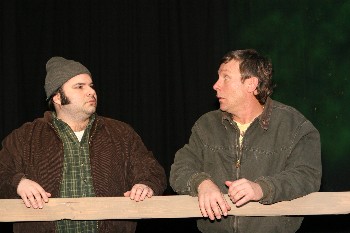
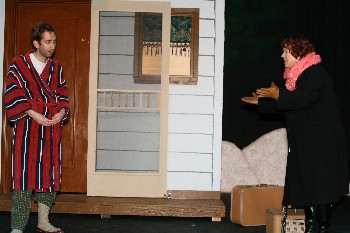
And the stories in this John Cariani-penned script are all quirky and funny, in a way that
heartens to community theater's usual light, comedic fare but is
nuanced and subtle. There are a few dark undertones --
unraveling and abusive relationships make appearances, as does
plain old loneliness -- but they only give greater depth to the
humor in the play.
The show is exceptionally
well-cast. There wasn't an actor who felt out of place in his or
her scene Friday night, and there are some real gems in here.
Each actor had characters that were thematically similar, and
from Driftwood veteran Margaret Tingwall's desperate, slightly
unhinged travelers to newcomer Sara Gray's disappointed,
heartbroken women, the pairings were pitch perfect.
Deserving special note is Ben
Hohman, who gave his folksy, slightly sad-sake characters a lot
of empathy and humanity. But he's just one of many good
performances, and it doesn't seem fair to leave out Jason
Whited's performance in a scene in which he declares his
feelings for his buddy, Karissa Rask's demanding ex-girlfriend,
Bryan Blackburn's book smart-but-stupid-about-girls character,
Debbie Lansing's just-been-hit-by-cupid sweetheart or Cheyenna
Carroll's naive-but-game tomboy. And Ed Logue, given some of the
more outlandish situations, managed to keep his characters --
from a repairman struck with unlikely love to a person with
developmental disabilities, and an inability to feel pain --
from being cliche.
The vignettes in "Almost, Maine,"
are written sparingly and with as much hinted at as actually
said (there's a reason for the "Almost") -- Mainers are known
for their reserve and laconic nature -- and the play is handled
with the same restraint by the actors and in the minimalist set
deign.
With so much gentle whimsy at
play -- we're talking literal bags of love here, people, and a
woman with a broken heart she carries around with her in a bag
-- "Almost" could have turned into a snow globe of tweeness.
Thankfully, rather than overwhelm us with details or drench us
with sentiment, we, the audience, come to the story and the
characters. It's an impressively absorbing experience, and it's
one where, by the end of the night, we can see the town of
Almost coalesce, with it's plywood mill workers, Moose Paddy
frequenters, apartment-dwellers and old married couples, what
with its citizens having bared their hearts to us.